More research which will eventually go into the Young Ladies' Survival Guide in Visiting Bath - sorry about the formatting it did horrible things to my numbered bullets
The Inhabitants of Milsom Street 1801-1820
Built in 1762, by Thomas
Lightholder, Milsom Street is mentioned in most novels about Bath, as a centre
for shopping for fabrics and jewellery and clothes. As seen in the list of shops, it was not the
exclusive centre of shopping, but certainly it contained many shops. The other main shopping streets were George
Street, New Bond Street, Old Bond Street and Bath Street.
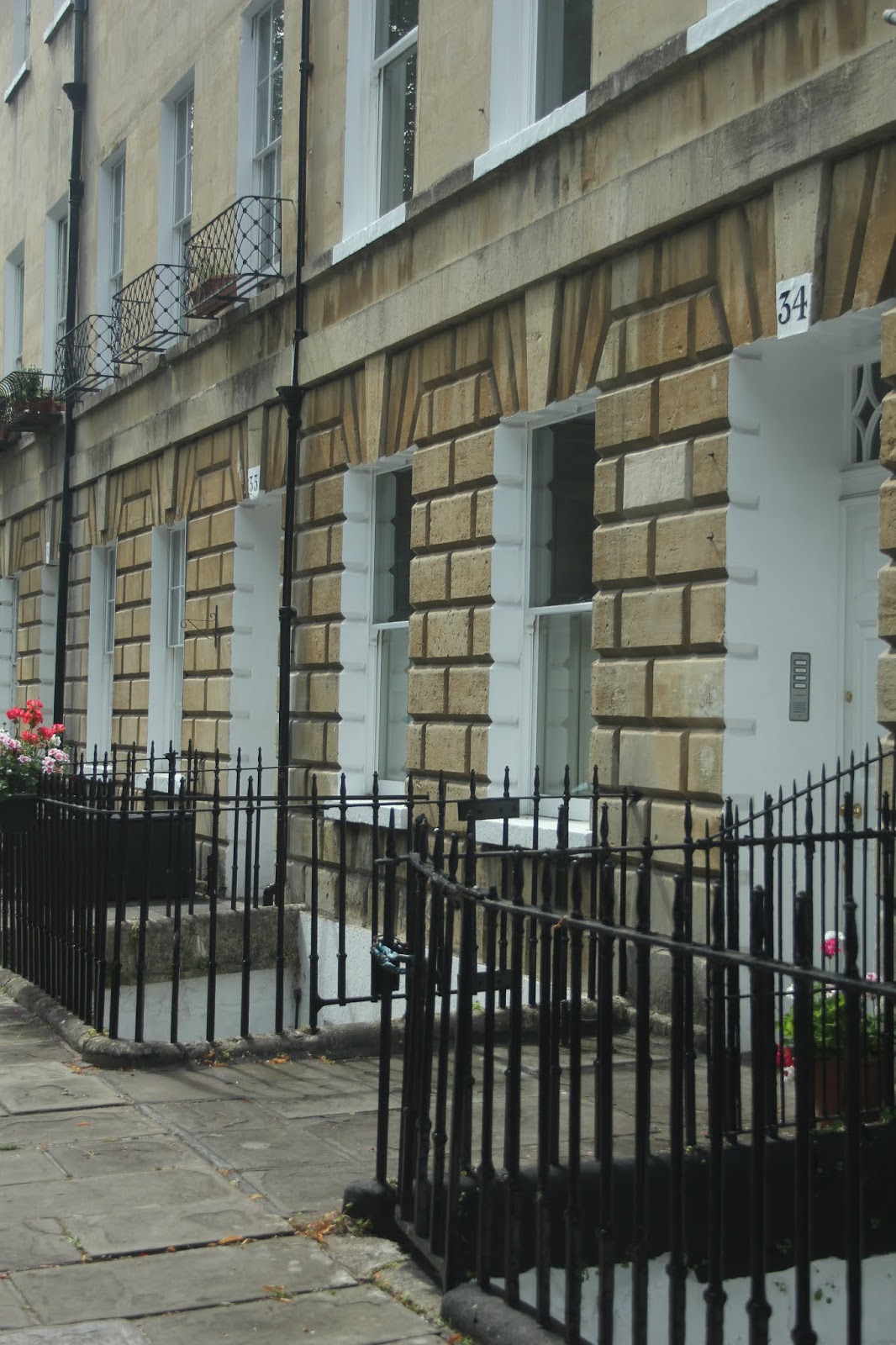
Milsom Street is an amazing
street. It contains buildings which are detached, and others which are
terraced. But those which are terraced
are grand terraces, like Somerset Buildings, 37-42. Grand frontages with columns, bowed centres
and in-your-face Palladian architechture turns a block of five houses into
something which would not be out of place as the residence of an earl, if only
placed into a country setting, not on the street.
Numbering of Milsom Street is
also not as we are used to; even and odd do not denote the side of the
street. Instead, the numbering starts
with no. 1 on the west side of the street at the northern end – where a number
of roads like Old Bond Street start – and numbers up the western side to no. 23
on the corner of George Street.
Immediately opposite no. 23, numbering recommences with no. 24 and runs
down to no. 47, opposite no. 1.
The buildings are, on the
whole, 4 storey, with basement as well, and often double-bayed. Many of them are broken up into multiple
occupancy, typically with shops and the rooms behind them on the ground floor,
and residences or boarding houses above.
Most boarding houses offer ‘rooms for gentlemen or families’; single
ladies rarely mentioned, only by the Misses Kyan of no. 42
Those houses whose occupancy
I have not been able to trace may be presumed to be private dwellings or
boarding houses which advertised by word of mouth rather than through the
newspapers.
West Side
1
1 In April 1816
White’s Pianoforte and Music Warehouse (also on 5 George Street)
Speculated:
the un-numbered Music Warehouse of Mr. William Loder, band-leader and violin
maestro of the Theatre-Royal, who has a music warehouse in Milsom Street from
1818.
Numbers
2-22 are a terrace named Portland Place
2
2 Unknown
3 3
Unknown
4 4 In 1807 was
called Civet-Cat, occupied by a Mr. Gould, a perfumer and hair cutter, who also
provided wigs and hair pieces.
5 5 Unknown
6 6 Unknown
7
7 1794-1804,
owner-occupier J. James, fine muslins and table linen. He moved and let the
premises.
Until
March 1817 Thos. Sheppherd and Jas. Trinder, woollen drapers, hatters and
undertakers; in March 1817, they dissolve the partnership and Thomas Sheppherd
continues alone.
8 8 Leased for 99
years in summer 1765; the occupant dies age 79 in 1813, the lease being for sale for £300, plus
yearly ground rent £4/6/-. There was a
tenant-at-will Mr. John Howell who paid the ground rent and £130 a year rent.
9
9 1803 E. Sandys,
child-bed and ready-made linen warehouse.
In Feb 1817 the leasehold dwelling house and shop were for sale.
1 10 Jan 1801 sold by auction. The centre house of Portland
Place.
By
1811 Bally and Bartrum, auctioneers, also letting-agents, ie doing the job we
should now call estate agents. Mr. Bally
also kept a public library with reading rooms. Still there in 1820.
November
1820, the house was being let, furnished, by the year or less; Bally &
Bartrum were still operating out of
their ‘Great Rooms’ there which is now numbered ‘number 5, Central House,
Portland Place’.
111 Unknown
112 Mr. Henry Bowen until 1806 when the premises was sold
to cover his bankruptcy.
1807
Lockwood and Porter linen draper, leave May 1812
1815-1820
Public Library, C. Duffield Bookseller and publisher
ALSO
from Nov. 1816 Mr. Kay, cutler, jeweller
and plated goods.
113 Unknown until the 1820s when it became Jolly’s Bazaar,
and is still Jolly’s department store to this day, under the House of Fraser.
114 In 1812 it was a lodging house, to be let; the shop
frontage and shop separate.
115 In 1820 Mr. Cuff, Chemist
116 Up to 1809 P. Nonnet, Jewellery, perfumery, wigs etc Tunbridge-ware,
selling up stock May 1809 to move to London
117 Unknown
118 Mr. William Evill, auctioneer, upholsterer, appraiser,
undertaker and letting office.
ALSO
1816-1818 at least William Bell, Upholsterer.
119 1801 Charles Smith Bookseller
1804
Mrs. Mary Smith, relict of Chas. Smith, with her brother Henry Godwin
Bookseller and stationer.
1808
H. Godwin moves out with his business to Public Library to No. 43. Did Mary die?
1816
Mrs. Vesey moves from Bath St.; Haberdashery.
Gives up business 1820
From
Feb 1820 Abraham and Levy, jewellery
220 From January1816 new auction rooms Mr. Stafford, auctioneer, upholsterer, paper
hanging. Still there in 1820
221 Sold in April 1807.
Probably lodging houses in upper floors; given as address of Mr. Elliston,
actor, first staying temporarily in 1811 and then permanently.
1811 [probably the
ground floor] Mr. Webb auctioneer [possibly later in partnership with Mr. English].
Upholstery, carpets, paper hangings.
1818 Messrs English,
English and Becks, Auctioneers, same
1820
222 Unknown
223 Russel and Brookman, silks, velvets, gloves etc;
dissolve partnership July 1811
After alterations, Oct
1819 shop bought S&J Martin, jeweller, silversmith and watchmaker
East Side
1 24
Oct 1811 Peter
Ardenond moves in from Abbey Churchyard. Woollen Draper, Tailor, Habit Maker. Apartment
to be let at will. Moves out to the Colonnade House, 9, Bath St., October 1817,
to set up a bazaar.
Unknown time, Mr. Denie
– presumably 1817-1820
1820 Thomas Flaherty, successor
to Mr. Denie,Woollen Draper, Habit maker, Tailor, second premises; also uses
no. 27.
Possesses baroque
details not seen on other buildings.
2 25
Owned by ‘a lady’
who died early 1812
3
26 Unknown
4
27From Dec 1812 Mrs.
R. Spornberg, Milliner, mantua-maker until June 1819.
1819 Thos. Flaherty,
see no. 24
5 28 Dec 1811 Mr. Basnett
first advertises, is certainly there 1813; goldsmith and jeweller, continuing
from his father.
ALSO
July 1818 Mr. Holbrook selling large furniture removing to Catherine place –
probably in second occupancy with Mr. Basnett?
6 29 1805-1811 S.N.
Riviere [moved in from no. 32] Jeweller
7 30 Jan 1818 The
Rocking Horse and Golden Fleece, J Spreat, perfumier, toy and fancy goods.
8
31 From Nov. 1808
Mme Simeon, French Laces, bankrupt Jan 1811
Later 1811 C. Simeon,
French Laces [her son?]
9
32 1801 S. N.
Riviere Jeweller[of 63 Bond Street London] until 1805 when moves to no. 29 q.v.
1820 the whole house
with exception of two parlours to be let.
133 1801 Frederick Albrecht, stay, habit and gaiter-maker
to Her Highness Duchess of York. Moved from 7 George St.
Mrs. Albrecht to help
the ladies.
134 Jan 1805 -1810 [at least] E & A Laing, Millinery,
Haberdashery, dresses and pelisses
ALSO
Mr. Andras, booking pleasure and packet boats on the Kennet and Avon Canal
135 Prior to 1893 Mrs. Prynn, private occupier; sold June
1803
136 1811-1815 at least, Mr. Fasana, repository of arts,
silver, plated goods, oil paintings etc.
As part of his repository of arts, Mr. Mackie, teaching ladies shoe
making.
Numbers 37 - 42 are a terrace
called Somerset Buildings. An elegant central bow.
137 1802 Mr. Daniel, Miniature painter
1811 Mrs. M. Langdon
moves from Argylle St.; Hosiery, millinery,
dresses, haberdashery and Imperial corsets.
Still there 1815 at least
138 From June 1819 J&R Spornberg, milliner, mantua-maker;
moved from no. 27 which was sold out from under them when the owner went
bankrupt.
1
Numbers 39 and 40 were owned
by a Mr. W.Glover, sold 1801
139 AKA ‘The Centre House’. By 1805 Messers Slack Haberdashery who sold to Mr. W. Crocker in 1816, who was still
there in 1820. In 1817, when the whole upper house was let as ‘having been and
suitable for a boarding house’. [The upper rooms were a boarding house.]
1820 Mesdames Urry and
Huffown were keeping a boarding house, successors to Mrs. Bless
140 AKA Wellington House. May have been sold by Mr. Glover
to someone initialled A.B.
1802 Sheffield plate
warehouse, mirrors, Japanned goods etc, said to be ‘at Glover’s’.
Up to Oct. 1817 Mr. Charles
Foreman, haberdashery and fine French laces. Stock sold, shop let separately to
house, the house is very elegant with patent water-closets. See also no. 42
1817 part to let;
taken on by Mr. Crocker, drapery, silks, shawls, still there 1820 [shop?]
1818 Mr. Hodgson Auctioneer Wellington House.[House?]Formerly
of Kay and Hodgson, 7 Union Street.
141 1801 Miss Wilson, quits premises in May
42 By 1804 C. Foreman;
Hosiery and Gloves also see no. 41
From October 1807 the Misses
Kyan’s Boarding House, having moved to a larger house from Henrietta Street. Would take ladies or gentlemen with proper
references. Purchases boarding house in Cheltenham as well, 1808 and at 19
Circus, Bath 1811 Weymouth 1816, when she is still living at 19 Circus, Bath
1810 Mr. and Mrs. Bloss
take on boarding house buying 11 ¾ years of lease left @ £136/10/- p.a.; it has
been newly papered.
2 43 Circulating Library and Reading Room; H. Godwin, bookseller,
printer, publisher, moved in1808 after leaving mo. 19. [he printed the original
of the map of Bath in the front of this book]
444 Unknown
245 Unknown
446 Before 1813 Mr. Bretton; jewellery. Quits business
June 1813. There is an arched entranceway to no. 46 which also gives access to
the Octagon Chapel.
Octagon Chapel
247 Detached building, massive 4-bay frontage with
pillars. Currently a bank and looks as
though it was built either to be a bank or some civic building.
A Mrs. Mirvan lived in Milsom
Street in 1818 but I have not tracked down which number.
The residents of Milsom
Street petitioned to be provided with gas lighting in 1818